
Reusable packaging sounds simple in principle. Use the packaging, return it, prepare it for the next journey and use it again.
But from our experience manufacturing reusable IBC solutions, we know that making packaging reusable is only part of the challenge.
Effective return logistics for reusable packaging can make the difference between a container that is simply capable of being reused and a packaging system that is commercially viable to use again and again.
When we developed Octobox, we didn’t just think about how our IBC would perform while full, we considered the complete journey – filling, storage, transportation, discharge, return, reconditioning and reuse.
Because for businesses transporting liquids, powders, granules and other bulk products, what happens after delivery can be just as important as getting the product there in the first place.
Find out more about the benefits of our reusable Octobox packaging.
Reusable Doesn’t Automatically Mean Easy to Return
A container can be reusable in theory, but if getting it back is expensive or impractical, how likely is it to actually be reused?
This is one of the challenges we designed Octobox to address.
Rigid drums and containers can take up as much space when empty as they do when full. That means businesses can find themselves paying to transport large volumes of empty packaging back through their supply chain.
Our Octobox works differently.
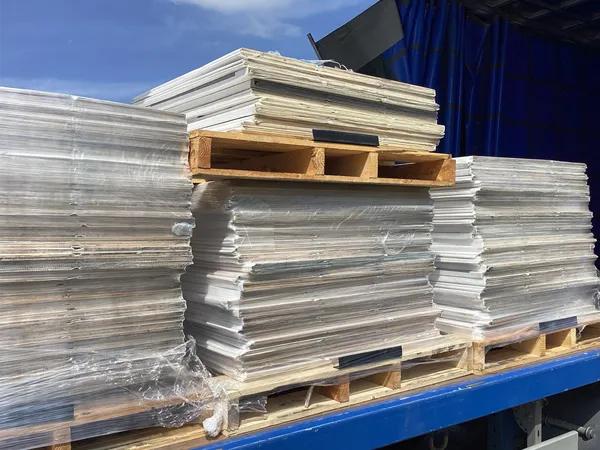
Once empty, Octobox folds flat, dramatically reducing the space needed for the return journey. This allows businesses to consolidate far more empty units into each return load, helping make repeat use commercially practical.
It’s a relatively simple design principle, but it can make a significant difference to the economics of reusable packaging.
If you’re currently using drums and considering an alternative, we’ve also looked at the differences in our Steel Drums vs Reusable IBCs guide.
We Believe the Cost of Packaging Goes Beyond the Purchase Price
When we’re talking to customers about their packaging requirements, we encourage them to look beyond the initial cost of the container.
What does it cost to fill?
How much warehouse space does it require?
How efficiently can it be transported?
How much handling is involved?
And probably most importantly…
What does it cost to get the packaging back?
The total cost per cycle gives a much more useful picture than purchase price alone.
For regular or high-volume routes, reducing the amount of space required to transport empty packaging can make a considerable difference over multiple cycles.
That’s why we believe the question shouldn’t simply be “How much does my packaging cost?”
It should be “How much does my packaging cost across its entire lifecycle?”
We Designed Octobox to Make Circular Logistics Practical
There’s an important difference between saying packaging is reusable and creating a system that makes reuse practical.
Our Octobox IBCs are designed to be returned, reconditioned and put back into service.
When full, their stackable design helps businesses make better use of warehouse and transport space. Depending on cargo weight and applicable safety requirements, our reusable IBCs can be stacked between two and five units high.
When empty, they fold flat to reduce the space needed for storage and return transport.
That combination matters.
It means we’re not relying on reuse as a sustainability message, we’ve designed the physical packaging and the return model around making reuse work in real supply chains.
Empty Packaging Still Takes Up Space
Return logistics aren’t only about transport.
We regularly talk about the efficiency of getting empty packaging back, but there’s another consideration… where does it go while you’re waiting to return it?
Warehouse space is valuable.
Large quantities of empty rigid packaging can quickly consume floor space that could be used for stock, production or other operational requirements.
Because our Octobox folds flat, empty units require considerably less storage space while waiting for their next journey.
For a business moving hundreds or thousands of containers, reducing the footprint of empty packaging can have a significant impact on overall warehouse and supply chain efficiency.
We Don’t Want an Octobox to Become Waste After a Few Journeys
This is an important part of our approach to reusable packaging.
Getting an Octobox back isn’t the end of its journey.
After completing multiple delivery cycles, our Octoboxes can be returned to us at Walton Industrial Containers for refurbishment. We inspect the units, recover and reuse components where appropriate and prepare them to go back into service.
This helps us extend the usable life of the packaging rather than continually replacing it.
It’s the combination of reuse, return logistics and reconditioning that makes our approach genuinely circular.
You can find out more about our reusable packaging and refurbishment model.
Where Does PPWR Fit In?
Of course, the conversation around reusable packaging isn’t happening in isolation.
Businesses operating within European supply chains are also adapting to the Packaging and Packaging Waste Regulation (PPWR), with greater emphasis being placed on packaging waste, reuse and lifecycle performance.
For us, these aren’t entirely new considerations.
We’ve been designing Octobox around reuse, return logistics and extending packaging life for years. The changing regulatory landscape simply makes those principles increasingly important for the businesses we work with.
We’ve put together an Octobox guide to PPWR explaining the Regulation and what businesses need to consider.
For the regulatory detail, you can also refer directly to the European Commission’s official information on packaging and packaging waste.
The Outbound Journey Is Only Half the Story
When we’re helping a customer find the right Octobox configuration, we don’t just ask what they’re transporting.
We need to understand the wider operation.
For liquids, that might mean considering filling and discharge, liners, product characteristics and the logistics model. You can read more about our reusable IBC solutions for liquids.
For powders and granules, the priorities can be different, which is why we configure our IBC solutions for powders and granules around the product and process.
But whatever you’re transporting, we’d encourage you to ask four questions:
How much space will your empty packaging occupy?
How much will it cost to return?
Can it be reconditioned and put back into service?
How easily will it fit into your existing logistics?
Because if reusable packaging doesn’t have an efficient route back, you’re only solving half of the problem.
Let’s Find the Right Octobox for Your Operation
We don’t believe in giving every customer the same Octobox configuration.
Your product, filling and discharge requirements, storage, transport and return model all influence the solution we’d recommend.
That’s why we’ve made it easier to tell us what you need.
Head to the Octobox homepage and click Configure Your Octobox, answer five simple questions about your product and requirements and we’ll use that information to help identify the right Octobox configuration for your operation.
Or, if you’d rather talk through your current packaging and return logistics with us, get in touch with our team.
We’re here to help.